What is Energy?
|

|
B. Two Main Forms of Energy: |
Kinetic energy is motion
energy.
Potential energy is energy stored in matter.
| In strict scientific terms energy is classified into
two main forms: kinetic and potential energy. Kinetic energy is
defined as the energy of a moving object. A thrown football, a
speeding automobile, a waterfall, or a rock falling from a cliff are
examples of objects that have kinetic energy. |

|
Potential energy appears in many different forms,
and is defined as the energy in matter due to its
position or the arrangement of its parts. The various forms of
potential energy include gravitational potential energy, elastic potential
energy, chemical potential energy, and electrical potential energy.
Potential Energy is often referred to as
stored energy. Some scientists avoid use of the word "stored" because it
inaccurately depicts energy as a substance that is contained within a
substance. In other words, some scientists and energy educators believe saying energy is "stored"
is a misconception.
|
|
Various Forms of Potential Energy |
 |
Gravitational Potential Energy
|
When something is lifted or suspended in air, work is done
on the object against the pull of gravity. This work is converted to a
form of potential energy called gravitational potential energy. When the
item succumbs to the force of gravity, falling towards Earth like an
apple from a tree, it converts potential energy into kinetic energy.
 |
Elastic Potential Energy |

|
A stretched rubber band has the
potential to do work or change things. This form of energy is called
elastic potential energy. It occurs when an object (such as our skin, a
spring, a trampoline, or a rubber band) resists being stretched out of
shape. The elastic potential energy in a rubber band can be used to do
work. For example, toy airplanes fly when a rubber band untwists and
spins a propeller. The elastic potential energy in the rubber band was
converted into kinetic energy.
 |
Chemical Potential
Energy |

|
It would take millions of rubber bands to move a real
airplane, so gasoline is used instead. But you don't stretch gasoline to
make it work, you burn it. The chemical makeup (arrangement of
molecules) of gasoline makes it a good fuel source. All nonliving and
living things, from automobiles to zebras, are made up of molecules. It
takes energy to make these molecules and hold them together. The energy
stored in molecules is called chemical potential energy. During
combustion, bonds are broken and reformed creating new products. The
energy stored in gasoline is released by burning it (combustion). During
combustion, chemical bonds are broken and reformed (changing gasoline
into byproducts such as water and carbon dioxide) releasing energy. The
airplane motor uses this released energy to turn a propeller. There are
many examples of chemical potential energy being converted to kinetic
energy to do work. The chemical energy in food is used by our bodies to
move. In a lighted firecracker chemical energy is used to make a loud
sound and to scatter pieces of the firecracker all over.
|
|
Electrical (Electromagnetic) Potential
Energy |

|
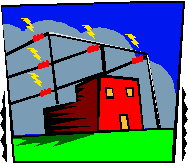
A battery has chemical potential energy along with
electrical potential energy. When you turn on a device that is
battery-operated, such as a flashlight or a toy, the electrical
potential energy stored in the battery is converted into other forms of
energy such as sound, mechanical motion, thermal energy, and light. For
an electrical appliance you plug in, the electrical potential energy is
maintained by a spinning generator of a power plant, hydroelectric dam,
or a windmill. A solar cell stores electrical potential energy similar
to a battery as long as the sun is shining on it.
When you feel a warm object, you are actually feeling thermal energy,
which is the movement of molecules that make up the object. All objects possess thermal
energy (even cold ones) since they have a temperature above absolute
zero. Evidence of thermal energy can be detected by measuring the
temperature of an object.
Although technically incorrect, the word heat is often used to mean
thermal energy.
A way to think about this distinction is objects possess
thermal energy, while heat is transferred from one object to another.
The Evidence of
Energy is All Around Us!
Sound, mechanical motion, thermal energy, and light are not
easily classified as kinetic and potential energy. They are evidence of
energy.
Light is an example of electromagnetic radiation and has no
mass, so it has neither kinetic nor potential energy. The remaining forms
have qualities of both kinetic and potential energy. Sound is made up of
vibrations (put your hand on a stereo speaker), thermal energy consists of
moving molecules in air or in an object, and mechanical energy is the
combination of kinetic and potential energy of a moving object. A pendulum
has mechanical energy; it continually converts kinetic energy into
gravitational potential energy and back into kinetic energy as it swings
back and forth.
A note about thermal energy and heat. In strict scientific
terms, there is a distinct difference between heat and thermal energy.
Thermal energy pertains to the kinetic energy of the molecules within an
object. Heat is the transfer of energy between two objects. Wherever
possible, we have tried to remain true to these distinctions. However,
since heat is the more familiar term we often use that to facilitate
understanding. |